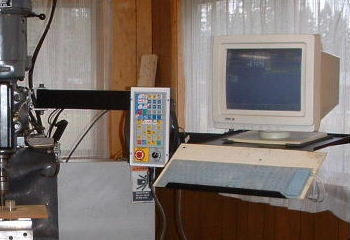
 A: The M39 uses a conventional PC keyboard and monitor,
which you supply, and a handheld pendant for the jog panel.
A: The M39 uses a conventional PC keyboard and monitor,
which you supply, and a handheld pendant for the jog panel.
Centroid CNC control sales, service, training and support
A: Yes, but it might not be worth the time, effort and expense.
Before you can install a CNC control on a manual mill, you will need to:
You will end up with a very versatile machine: one which can be run as a full 3-axis CNC; a semi-manual 2-axis CNC; or a manual mill with DRO position display.
However, if your objective is just to have a good CNC mill, you may well
save time and money by purchasing a good used CNC knee mill, such as a
Bridgeport Boss, a Shizuoka AN-S or ST-N, or a Supermax YCM-40, and
retrofitting it. These
machines often sell for as little as $1,500 to $3,000 in good mechanical condition
but with outdated and unreliable controls.
Q: How much does it cost to retrofit my older CNC mill or lathe?
A: That depends on a lot of factors. My customers have spent everywhere from $8,000 to $50,000 for control retrofits.
Basic Centroid 3-axis DC Servo CNC retrofit controls start around $12K for an M39S with a hand pendant, or $14K for an M400S with its complete console.
If your machine is fairly basic (a 3-axis mill or 2-axis lathe, without an automatic tool changer or any especially arcane gadgetry you want to keep), then you can probably do the bulk of the installation yourself. However, even with these machines you would do well to hire me for one or two days of professional help for the final setup, testing, and training in programming and operation.
If the machine has an automatic tool changer or other specialized devices that need to be integrated, then you will probably want to hire additional professional help with the wiring and PLC programming.
If you are busy and would rather spend your time designing and machining
parts, rather than tinkering with controls, then you can hire me to do
the entire installation. Depending on the machine, control, and your
location, this will usually take from four days to two weeks, and cost
between $3K and $10K Large and complex retrofits, such as the
Giddings & Lewis and Pratt & Whitney machines shown in my
retrofit gallery typically take three to
four weeks on site.
Q: What is the difference between an M39 and an M400?
A: The M39 uses a conventional PC keyboard and monitor,
which you supply, and a handheld pendant for the jog panel.
The M39 includes a support arm and tray. You can use whatever keyboard and monitor you like, from a surplus CRT to a modern LCD.
The M39 computer is in the upper part of the electrical cabinet, usually on the side or back of the machine.
The M39 is somewhat less expensive, and so appeals to the home market.
Also, with its walkaround pendant, it is a good choice for large-format
router tables.
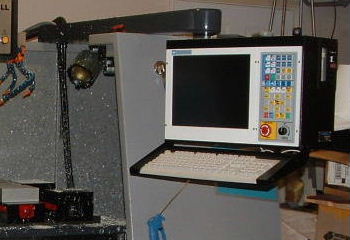 The M400 includes an industrial console, with the LCD display, keyboard,
and jog panel built in.
The M400 includes an industrial console, with the LCD display, keyboard,
and jog panel built in.
The M400 computer is inside the console, making access to the USB ports somewhat more convenient.
Aside from the console/computer arrangement, there is no difference
between an M39 and an M400. They run the same software, and have all
the same software and hardware options available.
Q: Do I need to buy the hand pendant with an M39?
 A: No, but I highly recommend it.
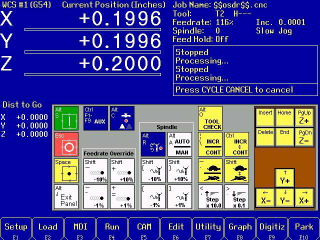
The control software provides a "keyboard jog panel", so you can use PC keyboard controls for machine jogging, spindle control, coolant control, etc..
If you omit the pendant and use keyboard jogging, you must supply and
wire in an appropriate Emergency Stop pushbutton.
Q: Should I pay extra for one of the pre-wire options?
A: Probably.
If you are proficient with electrical controls, and know where to buy contactors, starters, and shielded multi-conductor cable, then you can save several hundred dollars by sourcing these parts and installing them yourself.
If you just want a control that you can install quickly and easily,
then it is well worth your while to purchase either the M-function
or S-function prewire.
Q: Should I pay extra for the high-power upgrade option?
A: Perhaps.
For small knee mills using 29 in-lb motors, you do not need to extra power that this option provides. However, the option does give you a cleaner installation, in that there is only one power service connection (to 208-240 VAC power).
If you require 40 in-lb motors, or need to run on 480 VAC service,
then you need the high-power upgrade.
Q: Can I save money by reusing my old servo drives and motors?
A: Perhaps.
It is never worth re-using old DC servo amplifiers, because a new Centroid All-in-one DC control unit (which includes an integral 3-axis DC servo amplifier) costs only slightly more than the Oak control unit and interface cables which you would need to work with the old amplifiers.
If you have well-proven late model AC servo drives, like the Yaskawa
Sigma series, then you can control them with the Oak unit. The Oak
will provide signals for analog velocity-mode or torque-mode control
and also for pulse-train position-mode control.
Q: Okay, but what about using my Boss DC servo motors with the Centroid drive?
A: If you are doing your own installation, and you have the inclination and ability to adapt the old motor cables or make new motor cables, then it may make sense. If you are hiring me to do the installation, you will spend more on the additional labor to adapt to the old motors than you would spend on new motors.
Note that if you do keep the old motors, you may need to install new position encoders. Early Boss servo systems often used 250-line (1000-count) encoders. For optimum performance you should use at least 1000-line (4000-count) encoders. Centroid motors come standard with 2000-line (8000-count) encoders.
Also, some older motors will have TTL (single-ended) encoders. You need encoders with a differential line driver output (they should have 8 wires).
Copyright © 2017 Marc Leonard
Last updated 27-May-2017 MBL
