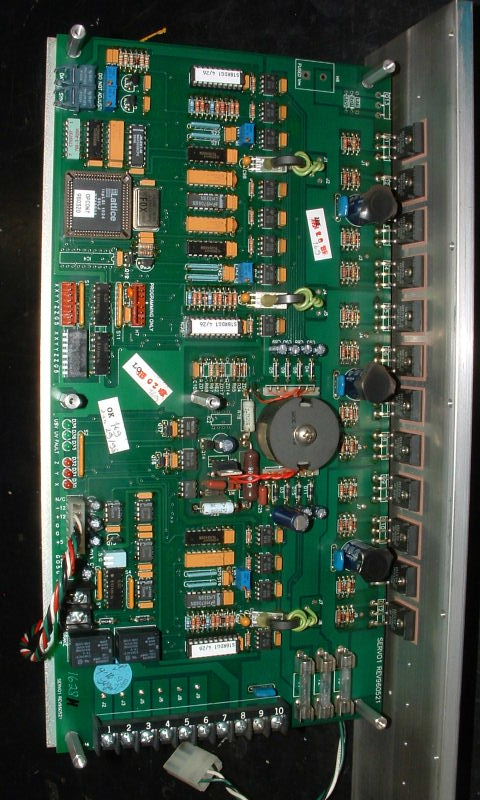
 Three-axis DC servo drive, nominal outputs from 9.5A to 25A per axis.
Centroid CNC control sales, service, training and support
These are servo drives (amplifiers) used in Centroid CNC controls from 1993 to present. Not all versions of all boards are pictured.
Three-axis DC servo drive, nominal outputs from 9.5A to 25A per axis.
Early models (through 1995) have a finned heat sink, and are mounted from the outside of the cabinet (you have to pass the drive unit through the slot in the cabinet to install and remove).
Later models (1996 onward) have a flat heat sink, and are mounted from the inside of the cabinet.
Used in all control systems from 1993 through 2002 except M15, CNCDRO, and OPTIC1 controls. Continued to be used in some M39 and M400 DC systems until the introduction of the DC3IO in 2004.
These drives are often identified by the axis and current combinations: e.g. "3-4T", "3-3T", etc.. The first number is the number of axes: 3 for a SERVO1 drive, 4 for a QUADDRV1 (see below). The second number is the number of turns of wire on the current sensor toroids, which in turn determines the current output:
| Turns | Output |
|---|---|
| 2 | 25A |
| 3 | 15A |
| 4 | 12A |
| 5 | 9.5A |
Command signals from the CPU board in the control computer are received via two optical fibers (DATA and SYNC), plugged into sockets in the upper left corner.
Motor power connections are via screw terminals across the bottom edge.
Terminals 7 and 8 (RLY1 and RLY2) on the bottom edge connect through a drive fault relay, which is closed if all is well. This is used as part of the emergency stop contactor coil circuit, so that bus power to the drive is cut off when the drive is in a fault condition.
Terminals 9 and 10 (GND and +VM) receive the bus power to run the motors. This is usually between 110VDC and 120VDC.
A holding brake relay is provided for the third (Z) axis. The relay will close whenever the third axis is enabled. This can be used to power an integral brake on the servo motor (e.g. to hold an unbalanced axis in place when control power is off).
The brake relay terminals are low on the left edge.
The 1/4" fuses adjacent to terminal 10 fuse the +VM line (plus side of
motor power supply) to each axis. They provide a small degree of protection
against damage due to a shorted motor or motor cable. More commonly,
a short will cause drive damage even with fast-blow fuses installed.
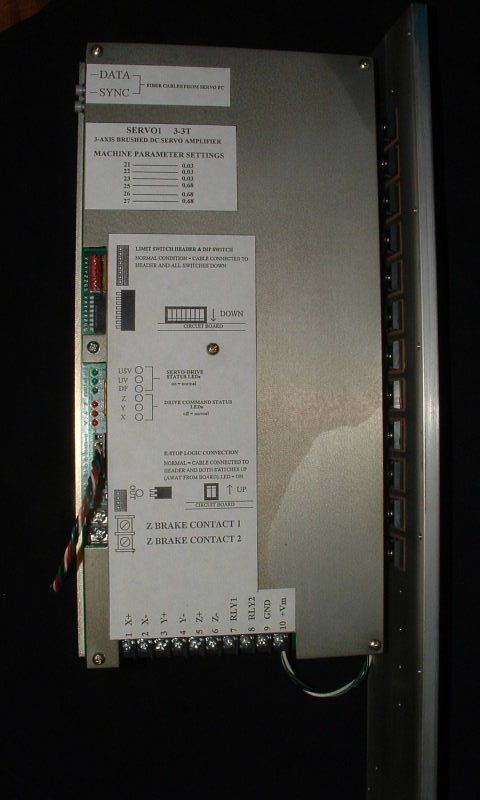 At right is a SERVO1 board with the cover plate in place.
In later production the
axis and current codes (e.g. "3-3T") were printed on the label, along
with recommended settings for the motor heating estimation parameters.
At right is a SERVO1 board with the cover plate in place.
In later production the
axis and current codes (e.g. "3-3T") were printed on the label, along
with recommended settings for the motor heating estimation parameters.
The header and DIP switches above the center support post along the left edge are for overtravel limit switches. The header has a connection for two switches per axis (plus and minus). The limit switch circuit must be closed to permit axis movement in the associated direction: an open limit inhibits current output.
The DIP switches are used to defeat the limit switches (force the circuits closed). They would be used in applications with no limit switches (e.g. rotary axes) and in troubleshooting.
In normal operation, the DIP switches are toggled down (toward the board), and limit switches are enabled. External switches must be connected and must be closed.
To defeat the limit switches, the DIP switches are toggled up (away from the board).
The red and green LEDs along the left edge report drive status. Earlier drives (through 1995) had six green LEDs:
| LED | Meaning |
|---|---|
| UV | Under Voltage. On = Okay. Off means motor voltage applied to VM terminals is below usable threshold (ca. 80VDC) |
| USV | Under Switcher Voltage. Usually echoes UV, as the switcher section also relies on the VM supply. |
| DF | Drive Fault. On = Okay. Off = fault detected (fiber optic failure, CPU not yet initialized, overcurrent, overvoltage, or overtemperature. |
| OV | Over Voltage. On = Okay. Off means motor voltage applied to VM terminals is above safe threshold (ca. 160VDC) |
| OC | Over Current. On = Okay. Off means one of the motors was drawing excessive current. |
| OT | Over Temperature. On = Okay. Off means the on-board thermal sensor exceeded a safe temperature. |
There are three red LEDs (one per axis). The red LEDs are on when the
associated axis is not enabled, and go out when the axis is enabled.
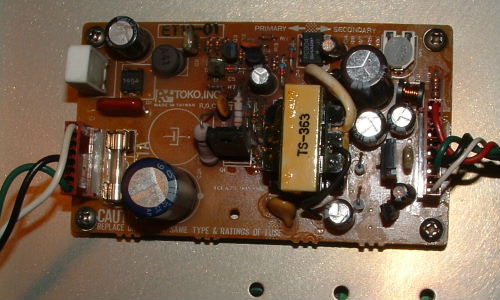 Logic power is provided by a small switching power supply mounted on
the back side of the drive. The logic power supply receives 120VAC input,
and puts out +5, +12 and -12 VDC for the drive's logic and control circuits.
Logic power is provided by a small switching power supply mounted on
the back side of the drive. The logic power supply receives 120VAC input,
and puts out +5, +12 and -12 VDC for the drive's logic and control circuits.
At right is a Toko logic power supply on the reverse side of an early model SERVO1 drive.
Later models used a green Cosel supply here, shown below.
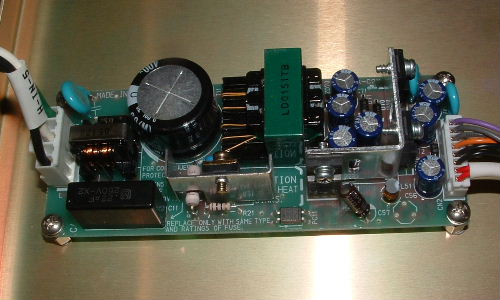
The 120 VAC connection to the servo logic power supply, whether it is a Toko or a Cosel, uses a 3-position Molex plug.
Most Centroid factory controls from 1996 onward used the Molex 3191-series plug shown on the left below. Many Revolution board-level controls, and pre-1996 factory controls, used the Molex 1396-series plug shown on the right below.
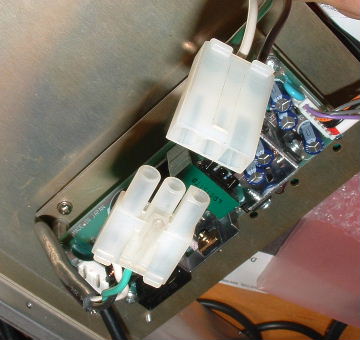 | 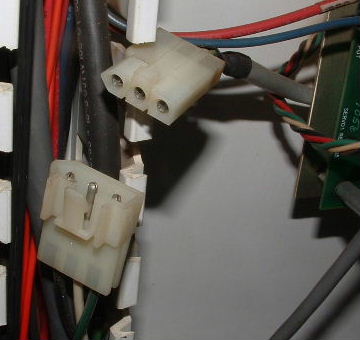 |
| Standard plug used on most Centroid controls after 1996 (Molex 3191) | Alternate plug used on Centroid controls before 1996 and on many Revolution controls (Molex 1396) |
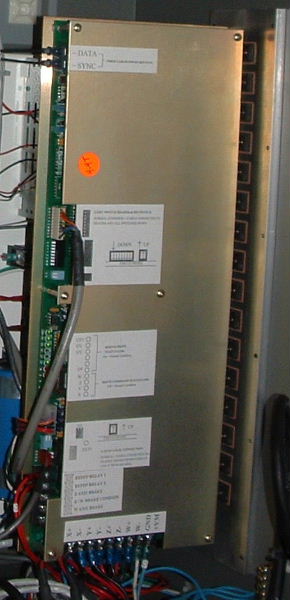 The QUADDRV1 is the four-axis version of the SERVO1 board. It has the same
basic features, but on four outputs.
The QUADDRV1 is the four-axis version of the SERVO1 board. It has the same
basic features, but on four outputs.
Because terminals 7 and 8 on the bottom of the drive are used for the fourth axis power output, the drive fault relay (RLY1/RLY2) terminals were moved to the left edge, adjacent to the brake relay terminals.
Holding brake relays are provided for both the third and fourth axes.
The QUADDRV1 was used on all four-axis DC controls during the same
period as the SERVO1 (ca. 1993 - 2004).
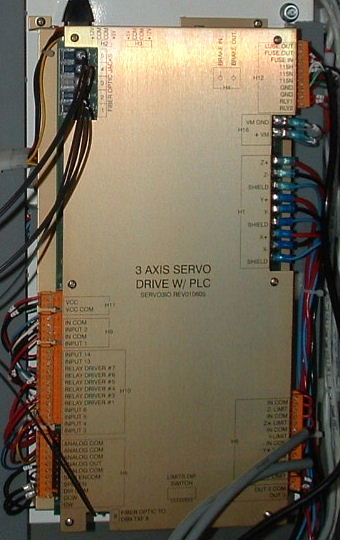 Three-axis DC servo drive combined with PLC I/O features.
This unit was adapted from the M15DRV1, for use in the low-cost,
full-cabinet "-S" model controls.
Three-axis DC servo drive combined with PLC I/O features.
This unit was adapted from the M15DRV1, for use in the low-cost,
full-cabinet "-S" model controls.
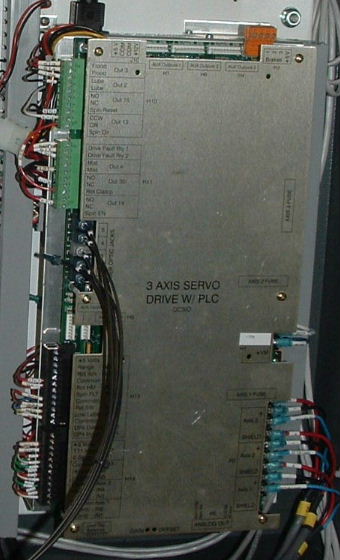
PLC capabilities include six limit switch inputs, eight general-purpose inputs, two relay outputs, five solid-state outputs, dedicated spindle control relays, and analog spindle speed control.
Used in M39S and M400S controls, mid-2002 through early 2004.
Five optical fibers connect from the CPU board in the console to the upper left of the SERVO3IO, carrying PLC I/O information and servo drive output requests.
A sixth fiber connects from a serial (RS232) transmitter on the back of the control PC to the bottom edge of the SERVO3IO, carrying spindle speed requests.
The printed cover plates on most SERVO3IO units contain errors: the top two terminals of H10 are general-purpose DC inputs. They are INPUT 14 and INPUT 15. The original cover plate labeled them INPUT 7 and INPUT 8; a later one labeled them as INPUT 13 and INPUT 14.
The original plate also had the top two fiber optic labels reversed. SYNC should be at the top, with DATA in the second position.
Also, some documentation purporting to show the internal function of
the lube pump connections on header H12 is incorrect. Counting from
the top, terminals 1 and 2 are connected together; terminals 3 and 4
are connected through the OUT2 lube relay. One side of the Quencharc
(arc suppressor) is connected to terminals 1 and 2.
 Three-axis DC servo drive combined with PLC I/O features.
This unit expanded on the SERVO3IO concept, with more numerous and
more flexible PLC inputs and outputs.
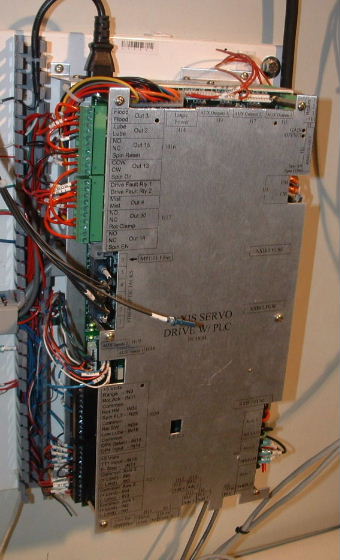
Three-axis DC servo drive combined with PLC I/O features.
This unit expanded on the SERVO3IO concept, with more numerous and
more flexible PLC inputs and outputs.
PLC capabilities include six limit switch inputs, twenty-four general-purpose inputs, seven relay outputs, twenty-three solid-state outputs, and analog spindle speed control.
Two different versions of the DC3IO board were released: the "042304" revision (April 2004) and the 040914 revision (September 2004). The later 040914 board is far more common in the field. Only a few of the earlier "042304" boards were shipped.
The two revisions are not directly interchangeable, though in general the later board can replace the earlier board with minor changes to the limit switch input wiring and software configuration; and the earlier board can replace the later board with those same limit switch changes, as long as the Auxiliary inputs are not used (see below).
Twelve of the DC3IO PLC inputs are "Auxiliary inputs" on pin headers H9 and H12. On the DC3IO 040914 revision, these auxiliary inputs can be configured as current-sourcing or current-sinking, at 5VDC, 12VDC or 24VDC.
Input SIP resistors must be installed to match the input voltage on each bank of Auxiliary inputs.
The DC3IO was used in M39S and M400S controls, mid-2004 to late 2008
 Three-axis DC servo drive combined with PLC I/O features.
This unit was an update to the DC3IO, designed to work with the
new-generation MPU11 motion processor. It can also be used with CPU10
and CPU7 systems, and so is a full replacement for the previous DC3IO.
Three-axis DC servo drive combined with PLC I/O features.
This unit was an update to the DC3IO, designed to work with the
new-generation MPU11 motion processor. It can also be used with CPU10
and CPU7 systems, and so is a full replacement for the previous DC3IO.
The firmware programmed onto the DC3IOB must be different for use with a CPU10, vs. what is needed for use with an MPU11. A DC3IOB cannot be moved between a CPU10 and MPU11 control without reprogramming at the factory.
PLC capabilities include six limit switch inputs, twenty-four general-purpose inputs, seven relay outputs, twenty-three solid-state outputs (twenty-four when used with an MPU11), and analog spindle speed control.
Details on replacing a DC3IO in the field with a DC3IOB.
Used in M39S and M400S controls, early 2009 to 2011.
 MPU11-based motion controller plus three-axis DC servo drive and PLC I/O unit.
This unit combines the features of the MPU11 motion control board and the
DC3IOB on a single board.
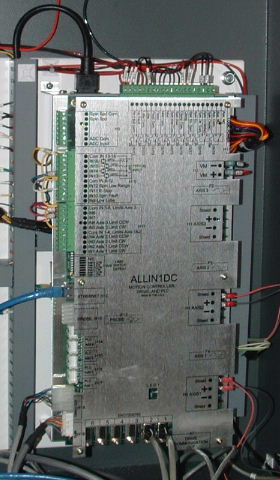
MPU11-based motion controller plus three-axis DC servo drive and PLC I/O unit.
This unit combines the features of the MPU11 motion control board and the
DC3IOB on a single board.
PLC capabilities include six limit switch inputs, ten general-purpose inputs, nine relay outputs, analog spindle speed control, and one general-purpose analog input.
The unit also has most of the MPU11 connections: six encoder inputs; jog panel, MPG and probe headers; and an ethernet port for communication with the controlling PC.
Headers are also provided for PLC expansion and servo drive expansion.
The PLC inputs can be configured as current-sourcing or current-sinking, at 5VDC, 12VDC or 24VDC. Input SIP resistors must be installed to match the input voltage on each bank of four inputs.
Low-voltage DC logic power is provided by an external switching power supply.
On the first generation of Allin1DC units (2010 through early 2014), this was a micro-ATX computer power supply, mounted to the back of the Allin1DC chassis. The "motherboard power" output of that supply plugged into a 20-pin ATX style (Mini-Fit Jr.) connector at H1 on the Allin1DC unit.
On a second generation in mid-2014, there were two enclosed MeanWell supplies mounted to the back of the chassis: one RT-50B to supply +5, +12 and -12; and an RS-15-3.3 to supply +3.3VDC. The logic power plug remained a 20-pin ATX connector (Mini-Fit Jr.), even though it combined wires from both MeanWell supplies. AC power for these two MeanWell supplies still came through a 3-pin IEC C13 receptacle mounted to the Allin1DC chassis (using a typical computer supply line cord).
On the third (and current) generation, beginning around October 2014, the
board was modified to generate 3.3VDC on-board from the higher-voltage supplies,
and H1 was changed to a 6-pin Mini-Fit Jr. receptacle. The logic power supply
was mounted separately to the panel, either behind the Allin1DC chassis, or nearby.
The logic supply could be either an RT-50B or an RQ-65D. The Allin1DC only
requires +5VDC, +12VDC, -12VDC and COM (0VDC). When an RQ-65D supply is installed,
its +24V output can be used for PLC input circuits. AC power to the logic supply
is hard-wired between screw terminals; there is no longer an IEC C13 plug connection.
 Each axis output can be configured for 6A, 9A, 12A or 15A output, using
a bank of DIP switches.
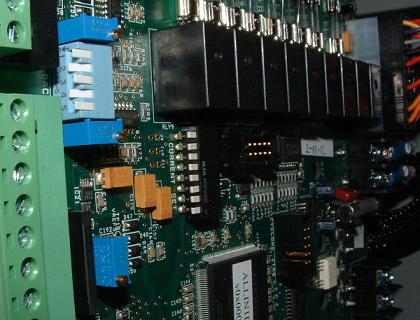
Each axis output can be configured for 6A, 9A, 12A or 15A output, using
a bank of DIP switches.
The switches are in SW1, the 8-position switch block near the upper left corner of the board, below the OUT1 relay. On units manufactured from 2011 through late 2016, the switch block is black, and the ON position is up, away from the board. On units manufactured after late 2016, the switch block is blue, and the ON position is down towards the board.
Settings are as follows:
| First Axis | Second Axis | Third Axis | ||||
| Current Setting | Switch 1 | Switch 2 | Switch 3 | Switch 4 | Switch 5 | Switch 6 |
| 6A | OFF | OFF | OFF | OFF | OFF | OFF |
| 9A | OFF | ON | OFF | ON | OFF | ON |
| 12A | ON | OFF | ON | OFF | ON | OFF |
| 15A | ON | ON | ON | ON | ON | ON |
Do not confuse SW1, the current-setting switch block, with SW2 and SW3, the blue 5-position blocks for setting the analog input and analog output ranges.
Early Allin1DC units, through late 2012, had drive-section capacitors that limited the safe DC bus voltage to around 130VDC or less.
Beginning in late 2012, the capacitors were changed to 250V units, allowing the overall DC bus voltage limit to be raised to 180VDC. That allows the option of using direct-rectified 120VAC power (ca. 169 VDC) for the motor bus, instead of requiring a step-down transformer.
The All-in-one DC is used in M39S and M400S controls, mid-2010 to present.
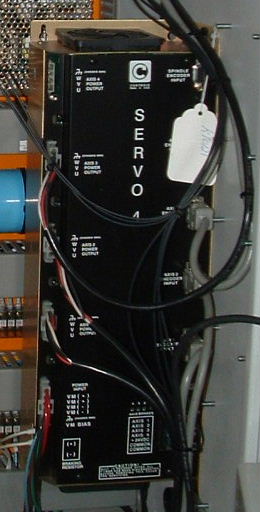 The SERVO4 was Centroid's first generation brushless AC drive,
introduced in 2003. It can power up to 4 motors, of up to 2kW each.
The SERVO4 was Centroid's first generation brushless AC drive,
introduced in 2003. It can power up to 4 motors, of up to 2kW each.
The SERVO4 communicates with the CPU board in the control computer over four optical fibers. It requires either a CPU9 or custom CPU10 board.
The SERVO4 was replaced in 2004 with the SD3 and SD1 family of drives.
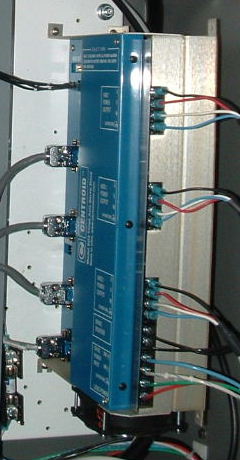 The SD3 was Centroid's second generation brushless AC drive,
introduced in 2004. It can power up to 3 motors, of up to 2kW each.
The SD3 was Centroid's second generation brushless AC drive,
introduced in 2004. It can power up to 3 motors, of up to 2kW each.
In addition to the encoder inputs for the three controlled axes, the SD3 has a port for a spindle encoder. This allows the spindle encoder on lathes and machining centers to be wired to the control cabinet, then forwarded to the CPU10 board via the drive's optical fibers (as the axis positions are).
An SD3 system can be expanded to four or five axes using daisy-chained SD1 drives (below).
These drives use four optical fibers, and require either a CPU10 or
a CPU9SD board in the control computer.
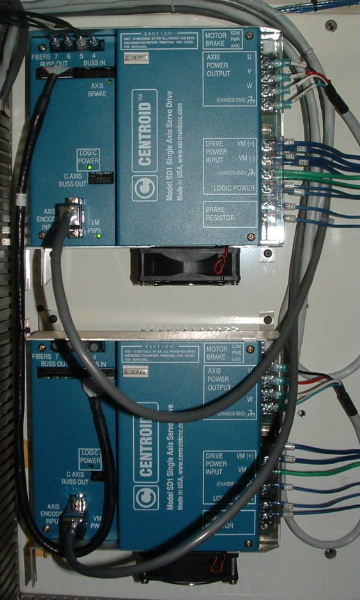 The SD1 uses the same design as the SD3, but in a single-axis package.
Multiple SD1 drives can be daisy-chained together. The SD1 can also
be added to an SD3 for four- and five-axis configurations.
The SD1 uses the same design as the SD3, but in a single-axis package.
Multiple SD1 drives can be daisy-chained together. The SD1 can also
be added to an SD3 for four- and five-axis configurations.
Shown at right is a two-drive SD1 system in a lathe application. The optical fibers from the console plug into the upper drive. A data bus ribbon cable connects the upper drive to the lower drive.
The standard SD1 can power up to a 2kW servo motor. A special high-power version can power up to 4kW motors.
The SD3 and SD1 were revised as the SD3B and SD1B, beginning in March 2008. The 'B' models have revised drive-to-drive communications for increased reliability. Original SD-series drives are not compatible with 'B' model SD-series drives. In a multi-drive system, then, one cannot be replaced with the other unless all drives in the system are replaced at the same time.
If an SD1 drive is the first drive in a system, it is connected to the controller board via the four optical fibers, and receives its communication over those fibers.
If an SD1 drive is an add-on drive, connected either to an SD3 or to another SD1, then it connects to the upstream (control-side) drive via a cable plugged into its "BUSS IN" header, coming from the "BUSS OUT" header of the upstream drive.
Jumper J16 on the SD1 drive determines the communication source. J16 is labeled "DIS FIBER", and is located in the upper left, about an inch below the bus communication out header ("BUSS OUT").
J16 should be removed if the drive's commands come directly from the control board via fiber optics. J16 should be installed if the drive's commands come from an upstream drive via a bus cable:
 | Commands via optical fibers from CPU |
 | Commands via cable from another SD-series drive |
The three axes of an SD3 drive are always axes #1, #2 and #3 in the control.
An SD1 drive, on the other hand, can be used in any position. The SD1 (and SD1B) therefore have jumpers to configure which axis each drive should respond as.
The jumpers are under the blue cover, immediately above the 15-pin encoder receptacle. They are used to set a binary value of 0 - 4, which indicate axes #1 - #5 in the system.
Jumper settings are as follows:
 | Axis #1 (X on a mill; Z on a lathe) |
 | Axis #2 (Y on a mill; X on a lathe) |
 | Axis #3 (Z on a mill) |
 | Axis #4 |
 | Axis #5 |
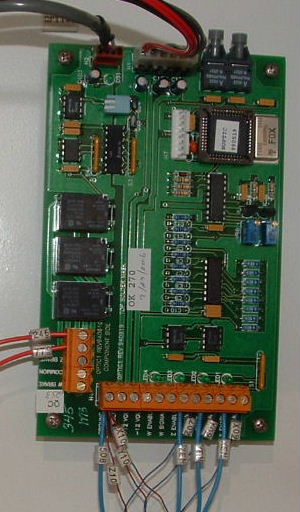 The OPTIC1 (and NOPTIC1) is a four-axis interface board which provides
+/-10V analog torque commands to third party servo drives capable of
torque mode control.
The OPTIC1 (and NOPTIC1) is a four-axis interface board which provides
+/-10V analog torque commands to third party servo drives capable of
torque mode control.
It receives commands from the CPU board in the console just like a SERVO1 or QUADDRV1 would, and so appears to the control software like a DC servo drive. The actual servos may be DC or AC.
The NOPTIC1 variant is more common than the true OPTIC1. The difference is in the drive enable outputs.
An OPTIC1 board pulls down its enable outputs to disable the axis drive. Each axis has a red status LED, which is lit (on) when the axis is disabled (like the red LEDs on a SERVO1 board).
An NOPTIC1 board pulls down its enable outputs to enable the axis drive. Each axis has a green status LED, which is lit (on) when the axis is enabled.
These boards have been used with a wide variety of third-party servo drives, including:
Like its parent QUADDRV1, the OPTIC1 has a drive fault relay and two holding brake relays. The holding brake relays apply to the third and fourth axes ("Z" and "W"). The board can be modified (cut and jump) to reassign one or both relays. This is most commonly done on slant-bed lathes, where the lathe's X axis (second axis) requires a holding brake.
Detail view of OPTIC1/NOPTIC1 board
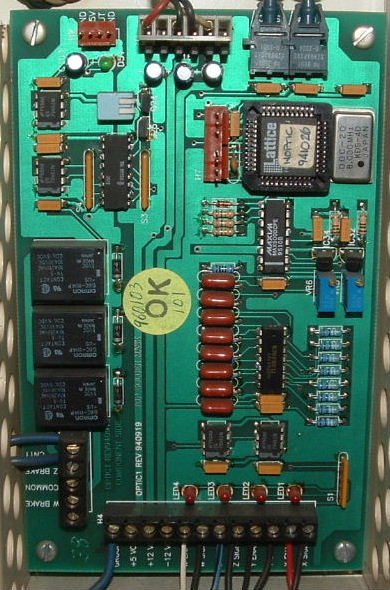 The term "OPTIC1" is often used generically to refer to either an OPTIC1
or NOPTIC1 board. If in doubt about which board you have, check the
label on the square PAL chip just behind the fiber optic sockets.
The term "OPTIC1" is often used generically to refer to either an OPTIC1
or NOPTIC1 board. If in doubt about which board you have, check the
label on the square PAL chip just behind the fiber optic sockets.
At right is an OPTIC1 board (note the red LEDs) that has been converted
to NOPTIC1 operation by changing the PAL chip.
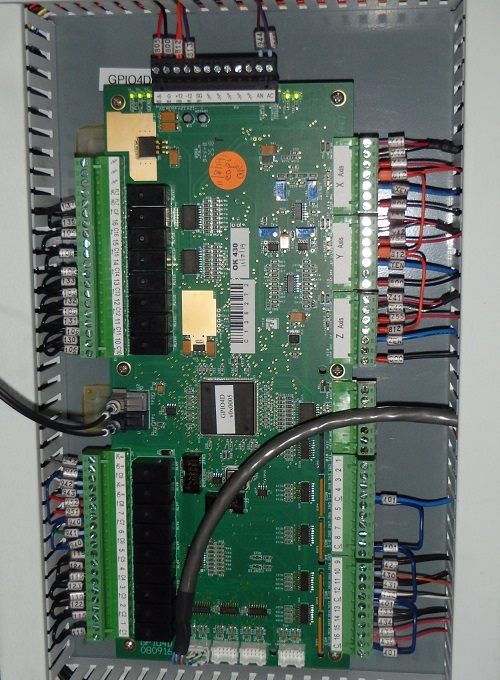 The GPIO4D is a combined 4-axis analog drive interface and 16-in/16-out
PLC board, used with the MPU11 motion control processor. It was used
with the majority of MPU11-family AC-servo control systems from 2010
through 2015.
The GPIO4D is a combined 4-axis analog drive interface and 16-in/16-out
PLC board, used with the MPU11 motion control processor. It was used
with the majority of MPU11-family AC-servo control systems from 2010
through 2015.
From 2010 through 2012, the GPIO4D served as both the servo drive interface and the primary PLC I/O board.
From 2012 through 2015, the GPIO4D was generally used as the primary PLC I/O board, while OpticDirect boards provided the servo drive interface.
GPIO4D continued to be used as the servo drive interface in systems which
required its greater flexibility and more open interface wiring, in comparison
to the OpticDirect and Oak boards. For example, with GPIO4D the servo drives'
fault output can be 5V, 12V or 24V, current-sourcing or current-sinking.
In contrast, OpticDirect and Oak require that the servo drives' fault output
be 24V, current-sinking (because the provided input is current-sourcing).
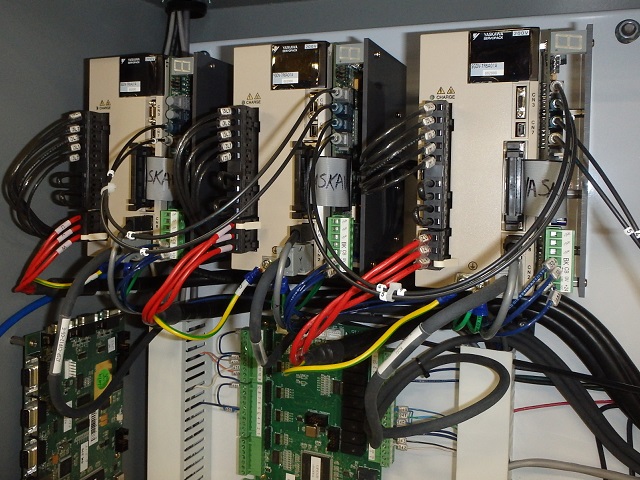 The OpticDirect is a single-axis drive interface, designed to simplify
interface wiring to Yaskawa Sigma-series and Delta ASDA-series servo
drives. It was introduced in 2012, and used in most systems with Yaskawa
and Delta servos until it was displaced by the Oak board in 2015-2016.
The OpticDirect is a single-axis drive interface, designed to simplify
interface wiring to Yaskawa Sigma-series and Delta ASDA-series servo
drives. It was introduced in 2012, and used in most systems with Yaskawa
and Delta servos until it was displaced by the Oak board in 2015-2016.
OpticDirect boards mount to the side of each servo drive, and connect to the drives' CN1 control interface receptacle with a short ribbon cable.
Communication between the MPU11 motion controller and the first OpticDirect board is via optical fibers. The remaining OpticDirect boards are daisy-chained from there, either via optic fibers or via shielded twisted pair cables. Jumpers on each OpticDirect board determine whether it is to receive commands via the optical fibers or the wired input; and whether it needs to repeat commands along the chain via its fiber optics.
Because the DriveBus protocol assigns the first (lowest) drive number to the farthest device in the chain, it is preferable (and most common) to run the fibers from the MPU11 to the "last" OpticDirect (e.g. the Z axis drive on a 3-axis mill), and then run the daisy chain in reverse order, ending with the first axis drive (e.g. the X axis drive on a 3-axis mill).
When swapping out OpticDirect boards, it is important to check the configuration
jumper settings ("wired input" and "fiber repeat") because they are different
depending on the board's position in the chain.
Copyright © 2022 Marc Leonard
Last updated 22-Jun-2022 MBL
